TortoiseshellNails:HowtoGettheGlossyAmberManicure
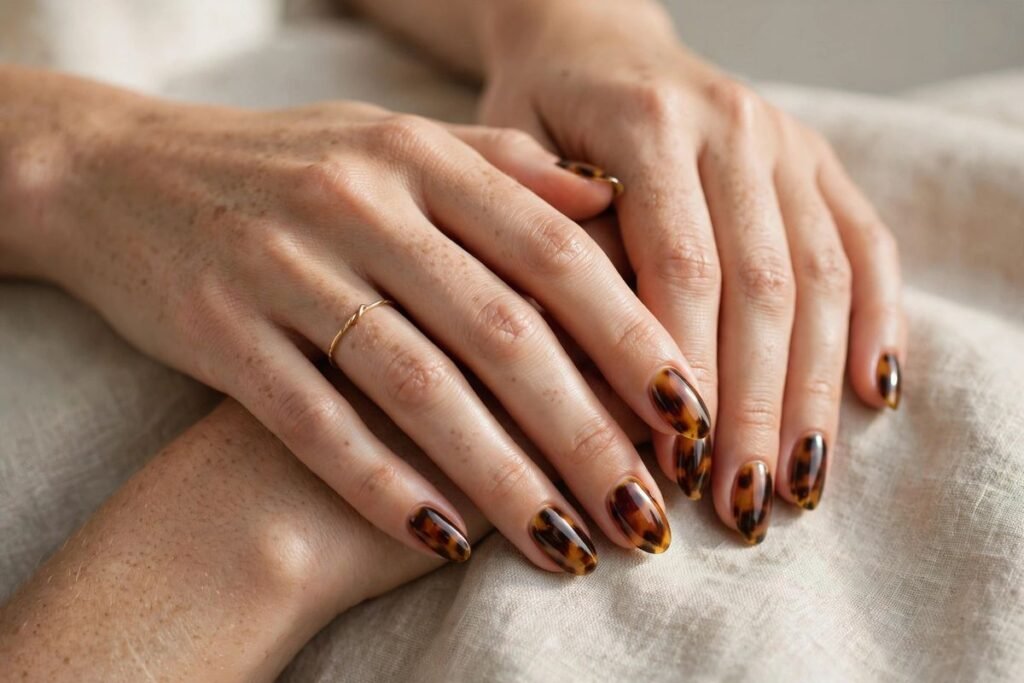
Table of Contents
Tortoiseshell nails are one of those rare nail trends that manage to be both bold and easy to wear. With their swirls of amber, honey, chocolate brown and black, they look like polished tortoiseshell jewellery, yet they sit comfortably beside almost any outfit. They are warm without being loud, patterned without being busy, and far more forgiving to paint than most nail art.
This guide explains what tortoiseshell nails are, how to create them at home with gel or regular polish, and which designs suit different nail shapes and lengths. You will also find advice on cost, longevity, styling and the mistakes that can spoil an otherwise beautiful manicure.
What Are Tortoiseshell Nails?
Tortoiseshell nails copy the mottled pattern of traditional tortoiseshell accessories, such as hair clips, sunglasses and jewellery. The look is built from translucent layers rather than solid blocks of colour. A warm amber or honey base is overlaid with irregular patches of brown and black, then sealed with a glossy top coat that gives the whole design its glassy depth.
The result should look organic rather than perfectly even. Real tortoiseshell is full of soft, uneven markings, so small variations from nail to nail actually make the manicure look more convincing. That is also why tortoiseshell nails are such a good first step into nail art: there is no symmetrical pattern to get wrong.
What You Need for Tortoiseshell Nails
You do not need a professional kit to try this look, but a few specific products make it much easier. For a gel version, you will need a base coat, a sheer amber or orange jelly polish, a chocolate brown gel, a black gel, blooming gel, a thin nail art brush or dotting tool, a lamp and a glossy top coat. Jelly polishes are important because their translucency creates the depth that makes tortoiseshell nails look glassy rather than flat.
- A sheer amber, honey or orange jelly polish for the base
- Chocolate brown and black polishes for the tortoiseshell markings
- Blooming gel, or a clear base coat if you are working without it
- A thin brush, dotting tool or toothpick for small, irregular spots
- A glossy top coat to seal the design and add shine
If you are using regular polish, choose sheer or jelly finishes where possible and work quickly while each layer is still slightly wet. You will not get quite the same glassy depth as gel, but you can still achieve a convincing tortoiseshell effect with careful layering and a high-shine top coat.
How to Do Tortoiseshell Nails With Blooming Gel
Blooming gel is the easiest route to realistic tortoiseshell nails. It stays wet under the lamp until cured, so colours placed on top of it spread gently and blend into soft, organic shapes instead of sitting as hard dots. Work one nail at a time so the gel does not dry out or get disturbed while you move on to the next nail.
- Prepare your nails, push back the cuticles and apply a base coat, then cure it.
- Apply one or two coats of sheer amber or orange jelly polish and cure.
- Add a thin layer of blooming gel and do not cure it yet.
- Drop small, irregular spots of brown and black gel onto the wet blooming gel.
- Use a thin brush to drag a few spots slightly, then leave the pattern to bloom for a few seconds.
- Cure, then add a second layer of amber jelly if you want more depth, and finish with top coat.
Less is more at the spotting stage. Start with only three or four small dots per nail and let them spread before adding more. It is easy to add another dot, but very difficult to remove colour once it has bloomed. If a nail looks too dark, wipe it clean and start again rather than trying to rescue it with extra amber polish.
How to Do Tortoiseshell Nails Without Blooming Gel
You can still create tortoiseshell nails without blooming gel, especially with regular polish. Paint a sheer amber base and, while it is still tacky, add small dots of brown and black polish with a dotting tool. Gently drag the edge of each dot with a thin brush so the colours feather into the base instead of sitting on top of it as separate spots.
Tortoiseshell Nail Designs to Try
Classic full tortoiseshell
The classic version covers every nail in the full amber, brown and black pattern. It is the most striking option and works beautifully on almond and oval shapes, where the length gives the pattern room to develop. Keep the rest of your look simple and let the nails be the statement.
Tortoiseshell French tips
For a softer take, keep the nail bed nude or sheer pink and paint only the tips in tortoiseshell. This is a good choice for work, weddings and anyone who finds a full pattern too bold. It also grows out more gracefully than a full design, which makes it practical if you cannot visit a salon every two weeks.
Accent nails and half moons
If you prefer a subtle introduction, try tortoiseshell on just the ring fingers, with the other nails in a matching chocolate brown or nude. A half-moon version, with tortoiseshell at the base of the nail and a solid colour on the rest, is another elegant compromise that still shows off the pattern.
Tortoiseshell with gold, chrome or colour
Tortoiseshell pairs beautifully with a thin gold outline, a chrome accent nail or a contrasting colour such as deep blue or burgundy on one or two nails. Gold jewellery in particular echoes the warm tones of the design. If you like metallic finishes, our guide to chrome nails shows how to combine shine with pattern without overwhelming the manicure.
Choosing the Right Shape and Length
Almond and oval shapes suit tortoiseshell nails best, because their tapered tips echo the smooth, organic feel of the pattern. Squoval nails also work well, especially for a French tip version. Very long, sharp stiletto nails can make the pattern look dramatic, but they also show every uneven spot, so they are better left until you are confident with the technique.
Short nails are absolutely fine for tortoiseshell nails. In fact, many people prefer the look on short, neat nails, where it reads as a polished neutral rather than a statement design. The trick on short nails is to keep the spots small and sparse, so the pattern does not crowd the nail plate. A single accent nail can be a good starting point if your nails are very short.
Salon or DIY? Cost and Longevity
In a salon, tortoiseshell nails usually cost a little more than a plain gel manicure, because the design takes extra time and skill. The exact price depends on your location, the salon and whether you choose extensions, but you are paying for the artist’s control of the blooming technique as much as for the products. Ask to see examples of the technician’s tortoiseshell work before booking, since results vary more with this design than with a solid colour.
At home, the main investment is the jelly polishes and blooming gel, which last for many manicures once bought. Gel tortoiseshell nails should last two to three weeks with proper preparation and a good top coat, while regular polish versions typically last around a week. In both cases, wear gloves for cleaning and avoid using your nails as tools, as chips show up more clearly on a patterned design.
When it is time to remove gel tortoiseshell nails, soak them off properly rather than peeling them. Peeling lifts layers of the natural nail and makes the next manicure weaker and less smooth. If you are unsure about removal, it is worth paying for a salon soak-off to protect your nails.
How to Style Tortoiseshell Nails
Tortoiseshell nails are a neutral in their own right, so they pair with almost everything. Gold rings and bracelets are the natural jewellery match, echoing the amber tones, but silver also works if the rest of your jewellery is cool-toned. Brown, cream, black and camel outfits let the nails stand out gently, while a bold colour such as emerald or navy creates a pleasing contrast.
For autumn, tortoiseshell nails sit perfectly alongside knitwear, leather and suede. Our guide to autumn nail colours offers more seasonal shades that pair well with this pattern, from deep burgundy to warm chocolate. For broader inspiration, Vogue fashion and ELLE fashion both showcase how patterned nails are styled on runways and in street style.
Common Mistakes to Avoid
The most common mistake is using too much black. Tortoiseshell is mostly amber and brown, with black as an accent, so a nail that is half black will look more like leopard print than tortoiseshell. The second mistake is applying layers too thickly, which traps bubbles, prevents proper curing and dulls the glassy finish. Do not rush the base preparation either: a smooth, well-shaped nail with pushed-back cuticles makes even a simple tortoiseshell design look salon-finished.
Practical Tips
- Practise on a nail wheel or one nail first before committing to a full manicure.
- Keep spots small and irregular, and let blooming gel do most of the blending work.
- Work one nail at a time so the wet layers do not get smudged.
- Add a second amber jelly layer for extra depth if the first looks too pale.
- Seal with two thin layers of glossy top coat for a glass-like finish.
Frequently Asked Questions
Are tortoiseshell nails hard to do?
No, they are one of the most forgiving nail art designs, because the pattern is meant to be irregular. Blooming gel makes the technique especially beginner-friendly.
Can I do tortoiseshell nails with regular polish?
Yes, using sheer amber, brown and black polishes while the base is still tacky. The finish will be slightly less glassy than gel, but the pattern still works well.
How long do tortoiseshell nails last?
Gel tortoiseshell nails usually last two to three weeks, while regular polish versions last around a week, depending on your daily activities and top coat.
Do tortoiseshell nails suit short nails?
Yes, they look elegant on short nails if you keep the spots small and sparse. Try an accent nail first if you are unsure about a full set.
Are tortoiseshell nails still in fashion in 2026?
Yes, tortoiseshell nails remain a popular autumn and year-round choice, thanks to their neutral palette and the way they suit so many outfits and occasions.
With a little patience and a light hand, tortoiseshell nails are one of the most rewarding designs to master at home. Start with the classic amber version, keep your spots small, and enjoy a manicure that looks expensive, feels wearable and never really goes out of style.