

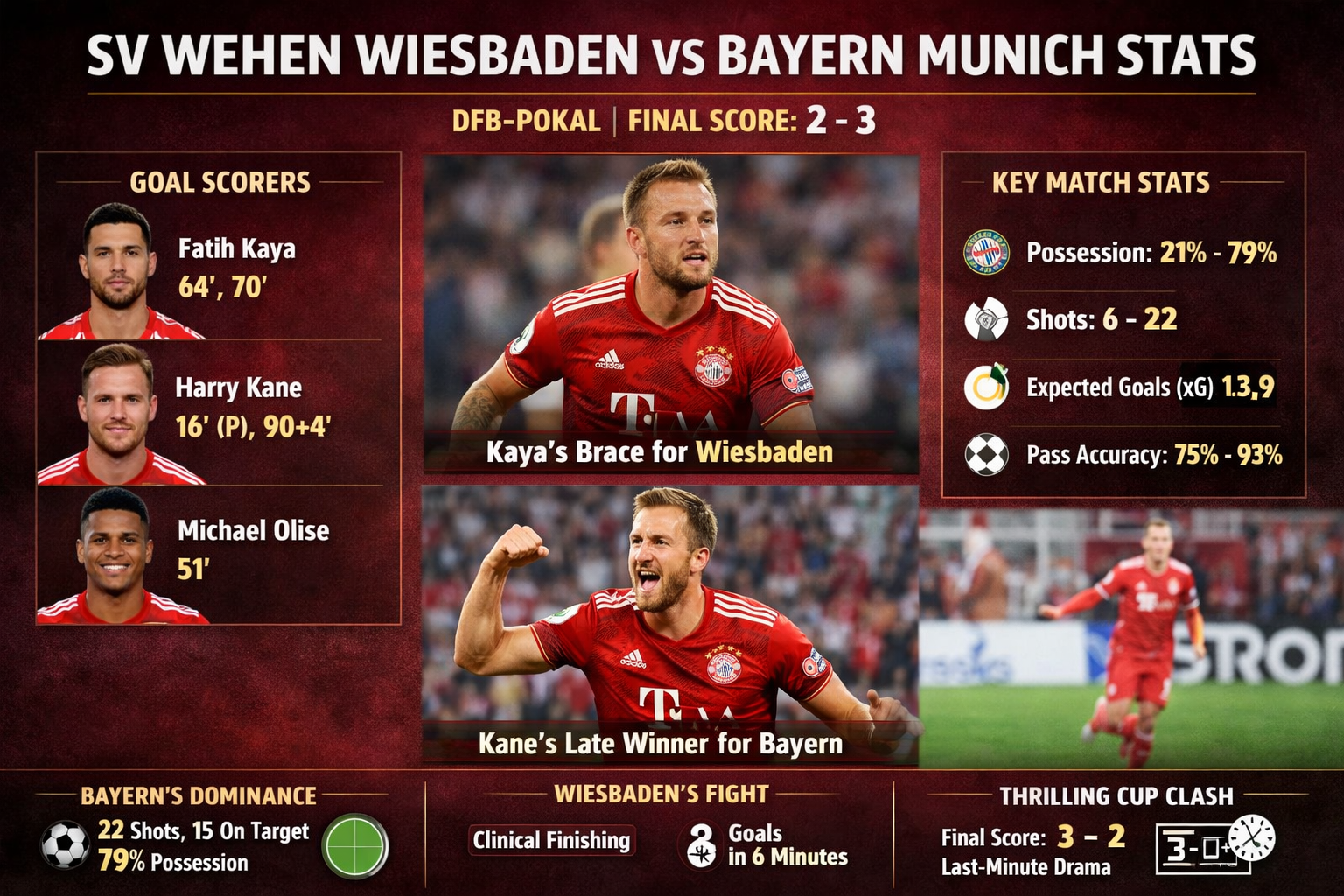
SV Wehen Wiesbaden lost 3–2 to Bayern Munich in the first round of the 2025–26 DFB-Pokal. Bayern dominated possession with about 78–79%, recorded 22 shots compared to Wiesbaden’s 6, and produced significantly higher expected goals. Despite the statistical gap, Fatih Kaya’s quick brace brought the underdogs level before Harry Kane scored a dramatic stoppage-time winner.
The match showcased Bayern Munich’s attacking strength and control, with 15 shots on target and over 90% passing accuracy. However, defensive lapses allowed Wiesbaden to score twice, proving that even when one team controls the stats, cup football can remain unpredictable.
Match Overview
The clash between SV Wehen Wiesbaden and Bayern Munich was one of the most exciting fixtures in the opening round of the German DFB-Pokal. Played at the BRITA-Arena in front of roughly 12,500 fans, the match delivered drama, goals, and surprising resistance from the third-division side.
Bayern entered the game as overwhelming favorites, and the statistics clearly reflected their superiority. Yet the final scoreline of 3–2 tells a deeper story — one of resilience from Wiesbaden and late heroics from Bayern.
Final Score and Goal Summary
- Final Result: SV Wehen Wiesbaden 2–3 Bayern Munich
- Bayern Scorers: Harry Kane (16’ penalty, 90+4’), Michael Olise (51’)
- Wiesbaden Scorer: Fatih Kaya (64’, 70’)
Bayern started strongly, taking the lead through Kane’s penalty before doubling their advantage early in the second half. However, Wiesbaden stunned the visitors with two quick goals, leveling the match within six minutes.
Just when extra time seemed likely, Kane delivered the winner in stoppage time, saving Bayern from a potential upset.
Possession Stats: Bayern’s Total Control
One of the most telling statistics from the match was possession:
- Bayern Munich: about 78–79%
- SV Wehen Wiesbaden: about 21–22%
This massive gap highlights Bayern’s typical playing style — patient buildup, constant ball circulation, and territorial dominance.
With nearly four times more possession, Bayern controlled the tempo and forced Wiesbaden into a defensive shape for most of the game.
Shots and Attacking Threat
The shot count further illustrates Bayern’s offensive pressure:
- Total Shots: Bayern 22 – Wiesbaden 6
- Shots on Target: Bayern 15 – Wiesbaden 2
Bayern created chance after chance, testing the goalkeeper repeatedly. Wiesbaden, on the other hand, relied on limited opportunities but proved extremely efficient when they attacked.
Interestingly, despite Bayern missing several big chances, their persistence eventually paid off.
Expected Goals (xG) Breakdown
Expected goals help measure the quality of chances rather than just quantity.
- Bayern Munich xG: roughly 3.8–4.1
- Wiesbaden xG: about 0.6–1.1
This statistic confirms that Bayern produced far more dangerous scoring opportunities. A difference of nearly three expected goals usually results in a comfortable win — but Wiesbaden’s clinical finishing kept the contest alive.
Passing Accuracy and Build-Up Play
Bayern’s dominance extended to their passing numbers:
- Accurate Passes: Bayern 847+ vs Wiesbaden around 185
- Passing Accuracy: Bayern about 93% vs Wiesbaden roughly 75%
These figures underline Bayern’s technical superiority. Their midfield controlled transitions, recycled possession effectively, and maintained pressure throughout the match.
Such precision is often the foundation of Bayern’s attacking success.
Corners, Discipline, and Defensive Work
Additional stats provide insight into the match dynamics:
- Corners: Bayern 7 – Wiesbaden 0
- Yellow Cards: 1 each
- Red Cards: None
Winning seven corners without conceding one shows how frequently Bayern pushed into attacking zones. Meanwhile, the low card count suggests a relatively disciplined encounter despite the intensity.
However, Bayern’s defensive organization briefly faltered during Wiesbaden’s two-goal surge — a reminder that even elite teams can lose focus.
Player Performances That Shaped the Match
Harry Kane – The Match Winner
Kane proved decisive once again. Scoring twice, including the stoppage-time winner, he demonstrated composure under pressure and elite positioning inside the box.
Fatih Kaya – The Unexpected Hero
Kaya’s brace shocked Bayern and energized the stadium. His ability to capitalize on defensive errors nearly produced one of the biggest cup upsets of the season.
Michael Olise – Creative Spark
Olise’s goal early in the second half seemed to put Bayern in full control. His attacking movement caused constant problems for Wiesbaden’s defense.
Tactical Analysis: Why Bayern Dominated
Several tactical factors explain Bayern’s statistical superiority:
1. Midfield Control
Bayern’s midfield dictated play, ensuring long spells of possession and limiting Wiesbaden’s attacking transitions.
2. High Press
By pressing aggressively, Bayern forced turnovers and quickly regained the ball.
3. Wide Attacks
Their use of width stretched Wiesbaden’s defensive line, creating shooting lanes and crossing opportunities.
However, defensive concentration briefly dropped — something top teams must avoid in knockout competitions.
First Half vs Second Half Statistics
First Half:
Bayern controlled the game and took a deserved lead. Wiesbaden struggled to create meaningful chances.
Second Half:
The match exploded into life. Bayern scored again, Wiesbaden responded with two rapid goals, and the tempo increased dramatically.
The final minutes showcased Bayern’s experience, as they pushed forward relentlessly until the winner arrived.
What the Stats Mean for Both Teams
For Bayern Munich
- Strong attacking output
- Elite passing numbers
- High chance creation
But the match also revealed defensive vulnerabilities that stronger opponents could exploit.
For SV Wehen Wiesbaden
Despite the defeat, the stats don’t fully capture their fighting spirit. Scoring twice from limited opportunities shows efficiency and belief — qualities that define dangerous cup underdogs.
Key Takeaways
- Bayern dominated nearly every statistical category.
- Wiesbaden proved that efficiency can challenge possession-heavy teams.
- Harry Kane’s late goal prevented a historic upset.
- Cup competitions remain unpredictable regardless of statistical gaps.
Conclusion
The SV Wehen Wiesbaden vs Bayern Munich stats paint a clear picture of dominance mixed with drama. Bayern controlled possession, created far more chances, and displayed superior technical quality. Yet football is not played on spreadsheets alone — Wiesbaden’s resilience nearly rewrote the script.
Ultimately, Bayern’s experience and attacking depth made the difference. The match serves as a perfect example of why knockout tournaments captivate fans: even when the numbers favor one side, the outcome is never guaranteed until the final whistle.
FAQs
1. What was the final score between SV Wehen Wiesbaden and Bayern Munich?
Bayern Munich defeated SV Wehen Wiesbaden 3–2 in a thrilling DFB-Pokal match, with a stoppage-time goal securing the victory.
2. Who scored the goals in the match?
Harry Kane scored twice for Bayern Munich, including the late winner, while Michael Olise added another goal. Fatih Kaya scored both goals for SV Wehen Wiesbaden.
3. Did Bayern Munich dominate the match statistically?
Yes, Bayern controlled possession with nearly 79%, recorded over 20 shots, and maintained very high passing accuracy, showing clear statistical dominance despite the close scoreline.
4. Why was the match closer than expected?
Although Bayern created more chances, defensive mistakes allowed Wiesbaden to score twice. Their clinical finishing and strong determination kept the game competitive until the final minutes.