

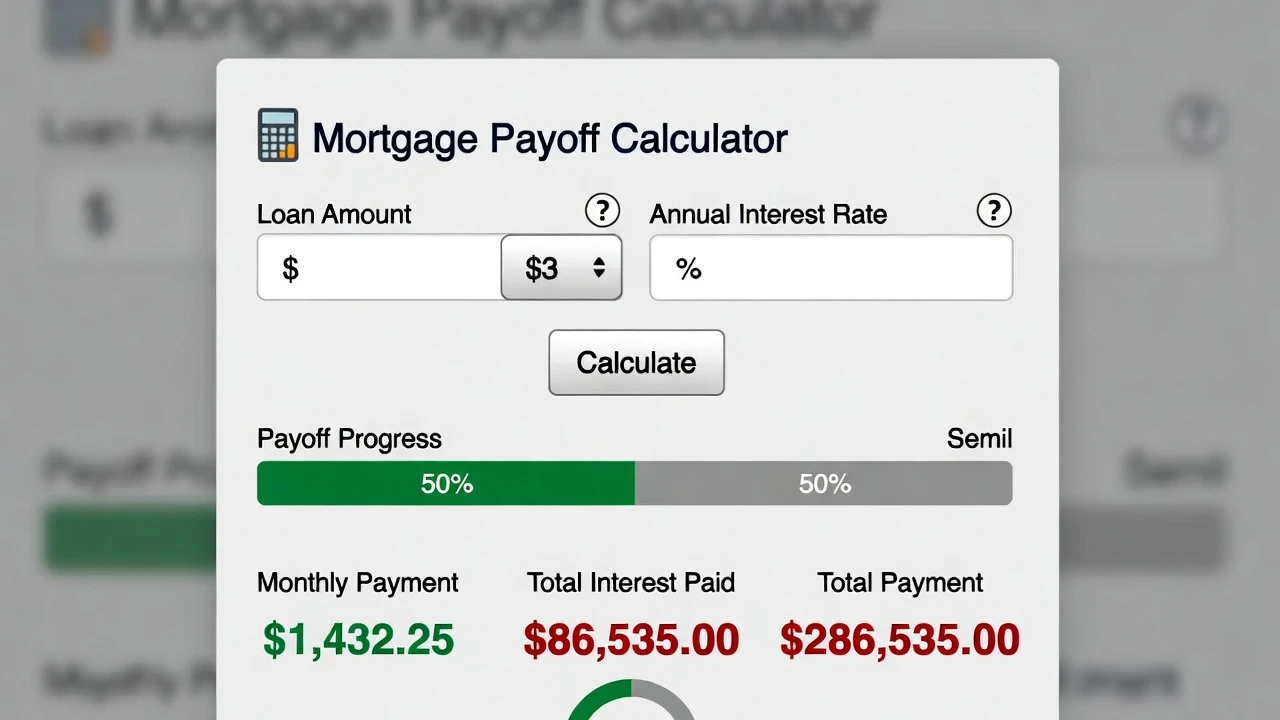
Managing a mortgage can be one of the most significant financial responsibilities for homeowners in the United Kingdom. A mortgage payoff calculator is a practical tool designed to help homeowners understand how long it will take to pay off their mortgage, how much interest they will pay over time, and the impact of extra payments or rate changes.
In the UK, mortgage terms, interest rates, and repayment options vary widely among lenders such as Barclays, Lloyds, HSBC, and Nationwide. Understanding your mortgage using a calculator can help you make informed financial decisions, plan for overpayments, and compare different repayment scenarios. This article explains what a mortgage payoff calculator is, how it works in the UK, and what factors affect its usefulness.
What is a Mortgage Payoff Calculator?
A mortgage payoff calculator is an online or software-based tool that estimates how quickly a homeowner can repay their mortgage based on various inputs. These inputs typically include:
- Current mortgage balance
- Interest rate (fixed or variable)
- Remaining loan term
- Regular monthly payment
- Optional additional payments
The calculator uses these details to project the total interest paid, the number of months or years until the mortgage is fully repaid, and the potential savings from overpaying.
Who is it for?
- First-time homeowners who want to understand repayment schedules
- UK homeowners considering overpayments
- People comparing mortgage products or refinancing options
- Anyone looking to plan long-term finances around their home loan
How a Mortgage Payoff Calculator Works in the UK
Using a mortgage payoff calculator is straightforward. Here is a step-by-step guide for UK homeowners:
- Enter Your Current Mortgage Balance
Include the remaining amount you owe in GBP. For example, £200,000. - Input Your Interest Rate
Use your mortgage’s annual percentage rate (APR), whether fixed or variable. - Specify the Remaining Term
Enter the number of years or months left on your mortgage, e.g., 25 years. - Input Your Monthly Payment
Include your standard monthly repayment (capital + interest). - Add Extra Payments (Optional)
If you plan to make overpayments, add these to see how much time and interest you could save. - Calculate the Results
The tool will show:- Remaining mortgage term
- Total interest paid over the term
- Potential interest savings with extra payments
Most calculators also provide a visual amortisation schedule, showing how each payment reduces the principal and interest over time.
Real Examples (UK-Based)
Example 1: Standard Mortgage
- Mortgage: £150,000
- Interest rate: 3.5% fixed
- Term: 25 years
- Monthly payment: £750
Using a mortgage payoff calculator:
- Full repayment in 25 years
- Total interest paid: ~£97,000
Example 2: With Overpayments
- Mortgage: £150,000
- Interest rate: 3.5% fixed
- Term: 25 years
- Monthly payment: £750 + £100 extra
Using the calculator:
- Full repayment in ~19 years
- Total interest paid: ~£72,000
- Interest saved: ~£25,000
Example 3: Refinancing Impact
- Mortgage: £200,000
- Current rate: 4% variable
- Refinanced rate: 3% fixed
- Term: 20 years
The calculator shows:
- Monthly payment reduction
- Shortened term if the current payment is maintained
- Potential savings in interest over 20 years
Pros and Cons
| Pros | Cons |
|---|---|
| Easy to estimate mortgage term and interest | Accuracy depends on correct input values |
| Allows scenario comparison (overpayments, refinancing) | Does not account for future interest rate changes in variable mortgages |
| Helps with financial planning and budgeting | Some UK calculators may not include fees or early repayment penalties |
| Visual amortisation schedule makes progress clear | Online calculators may differ in assumptions or formulas |
Key Factors That Affect a Mortgage Payoff Calculator
- Interest Rate Type
Fixed vs variable rates influence repayment calculations. Variable rates may fluctuate, altering results. - Overpayment Options
Lenders may limit overpayment amounts annually or charge fees, impacting payoff speed. - Mortgage Term
Shorter-term mortgages save interest but increase monthly payments; longer terms reduce monthly costs but increase total interest. - Fees and Charges
Early repayment fees or arrangement fees are not always included in basic calculators. - Payment Frequency
Monthly vs biweekly payments can slightly affect total interest paid. - Currency and Local Regulations
Ensure GBP inputs and FCA-compliant mortgage terms are considered.
Common Mistakes to Avoid
- Ignoring overpayment limits: UK lenders often cap overpayments; exceeding limits may incur charges.
- Entering incorrect interest rates: Always use your current APR for accurate projections.
- Forgetting fees and charges: Early repayment penalties or annual fees can affect savings.
- Assuming variable rates are fixed: Future changes in rates can alter payoff projections.
- Not updating balances: Regularly update the remaining mortgage balance for accurate calculations.
Is a Mortgage Payoff Calculator Worth It for UK Users?
A mortgage payoff calculator is highly useful for most UK homeowners:
- Who should consider it:
- Homeowners planning overpayments
- Individuals comparing mortgage deals or refinancing options
- People seeking clarity on the total interest and the term remaining
- Who may not benefit:
- Those with very short-term mortgages are already nearing completion
- People who do not intend to make changes or extra payments
Overall, it is an effective financial planning tool when used accurately and updated regularly.
Mortgage payoff calculator FAQs (UK)
Are mortgage payoff calculators accurate?
They provide strong estimates based on your inputs: balance, interest rate (APR), and remaining term. Accuracy depends on entering correct current figures. For variable-rate mortgages, projections may shift if base rates change. Always treat them as a planning tool, not a guaranteed payoff schedule.
Can I include overpayments in calculations?
Yes, absolutely. Quality mortgage calculators let you add regular monthly overpayments, one-off lump sums, or yearly overpayments. They then illustrate the reduced term and total interest saved. This is one of the most powerful ways to see the benefit of overpaying your mortgage.
Do calculators consider fees or penalties?
Basic calculators usually ignore arrangement fees, valuation fees, or early repayment charges (ERCs). More advanced mortgage comparison tools may include ERCs if you specify your product’s penalty period. Always read the assumptions: most free payoff calculators focus on capital and interest only.
How can this help with refinancing?
By entering your current mortgage details versus a new rate (and term), you can directly compare monthly payments, total interest, and payoff date. This helps you decide whether remortgaging saves you money after factoring in product fees. Many UK calculators also show break-even points.
Is it suitable for first-time buyers?
Yes, very suitable. First-time buyers can use mortgage payoff calculators to understand how monthly repayments are split between interest and capital, how overpayments accelerate equity, and what different mortgage terms (25 vs 30 years) mean for total cost. It builds confidence before speaking to lenders.