KarlLagerfeld:Life,Career,Chanel,Fendi&FashionLegacy
Table of Contents
Karl Lagerfeld: The Extraordinary Life, Career and Legacy of a Fashion Icon
Karl Lagerfeld was one of the most influential and recognizable figures in modern fashion. Over a career that lasted roughly 65 years, he worked with major fashion houses including Fendi, Chloé and Chanel, while also developing his own label and pursuing photography, publishing and other creative projects.
What made Karl Lagerfeld particularly unusual was his ability to work across different identities. His approach at Fendi was different from his work at Chloé, while Chanel demanded another interpretation of his design language. He also created an instantly recognizable personal image that became an important part of fashion culture.
But behind the sunglasses, white ponytail and black tailoring was a designer deeply interested in history, technology, photography, books and contemporary culture.
Who Was Karl Lagerfeld?
Karl Lagerfeld was a German-born fashion designer who became one of the most important creative figures in international fashion. He was born in 1933 and died in 2019 at the age of 85. During his career, he worked across several major fashion houses and developed his own namesake label.
The Metropolitan Museum of Art’s 2023 exhibition, Karl Lagerfeld: A Line of Beauty, examined his work across his long career, including his designs for Fendi and Chloé in the 1960s and 1970s, his work at Chanel from the 1980s onward, and his eponymous label.
Lagerfeld was much more than a fashion designer. He was also a photographer, illustrator, publisher, book collector and creative director. His career helped establish the modern idea of the designer as a wider cultural personality rather than someone who only creates clothing.
Karl Lagerfeld’s Early Career
Lagerfeld arrived in Paris as a young designer and quickly became involved with the French fashion industry. His early career included work with Pierre Balmain and Jean Patou, followed later by major creative roles at Chloé and Fendi.
These early experiences were important because Lagerfeld learned to move between different fashion identities. Rather than developing only one recognizable design formula, he adapted his approach according to the house he was working for.
His relationship with fashion also extended beyond clothing. He developed an interest in photography, art, literature, architecture and publishing, which eventually became important parts of his creative life.
Karl Lagerfeld and Chloé
Chloé became one of the important stages in Lagerfeld’s development as a designer. At Chloé, his work became associated with a softer and more romantic approach to ready-to-wear. The Met’s research on Lagerfeld identifies his Chloé work with some of the more lyrical and figurative aspects of his design vocabulary.
This period demonstrated that Lagerfeld could work outside the stricter traditions of classic couture. He was able to create fashion that felt more relaxed, accessible and contemporary while still maintaining a strong design identity.
Karl Lagerfeld and Fendi
One of the longest relationships of Lagerfeld’s career was with Fendi. Lagerfeld began working with Fendi in 1965, becoming the Roman fashion house’s first Artistic Director. His collaboration with the Fendi family lasted for 54 years.
The Famous Fendi FF Logo
One of Lagerfeld’s most recognizable contributions to Fendi was the FF logo. According to Fendi, Lagerfeld created the logo during his early period with the house. He also helped rethink the presentation and treatment of fur, moving away from some traditional approaches and experimenting with lighter forms, colours and more modern visual ideas.
His long relationship with Fendi showed how a designer could become deeply connected to a fashion house without being its founder. He helped build a visual language that connected Italian craftsmanship with modern fashion.
Why Fendi Was Important to Karl Lagerfeld
Fendi allowed Lagerfeld to explore a side of his creativity that was different from Chanel. The Met’s analysis of his work describes Fendi as an important expression of his modernist tendencies, while his work at Chloé displayed more romantic and figurative qualities.
This difference between fashion houses is one of the reasons Lagerfeld’s career is so interesting. He did not simply reproduce the same style everywhere. Instead, he adapted his creative vocabulary to different environments.
Karl Lagerfeld at Chanel
The most famous chapter of Karl Lagerfeld’s career began at Chanel. In 1983, Lagerfeld became Artistic Director of Chanel. Chanel’s official history credits him with bringing new energy to the house, developing ready-to-wear, revitalizing haute couture, and introducing new collection formats.
At the time, Chanel was already one of the most important fashion names in the world because of the legacy created by Gabrielle Chanel. Lagerfeld’s challenge was therefore not to create Chanel from nothing. His challenge was to make the house relevant to a new generation.
How Karl Lagerfeld Modernized Chanel
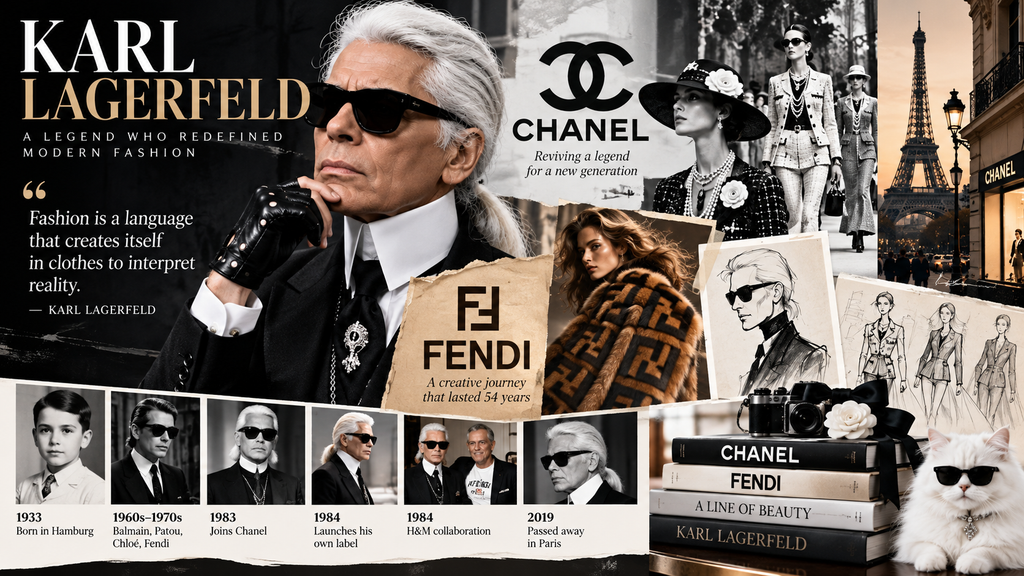
Lagerfeld repeatedly returned to recognizable Chanel codes while changing their context. Elements associated with the house could appear in new proportions, fabrics, combinations and styling. This allowed Chanel’s identity to remain recognizable while its collections continued to evolve.
The result was a relationship between heritage and modernity. Chanel itself credits Lagerfeld with restoring haute couture to greater prominence, developing ready-to-wear as we know it today and introducing the Métiers d’art and pre-collection concepts.
Karl Lagerfeld and Chanel Photography
Lagerfeld’s contribution to Chanel went beyond designing clothes. In 1987–1988, he created his first advertising campaign for Chanel as a photographer.
This was significant because Lagerfeld understood that fashion is communicated through imagery as much as through garments. He often photographed campaigns and editorials himself, giving him greater control over how collections were presented to the public.
Chanel’s Métiers d’Art and Karl Lagerfeld
Another important part of Lagerfeld’s Chanel career was the development of Métiers d’Art. Chanel’s history records the first Métiers d’Art collection, Satellite Love, in 2002. The format was designed to highlight the specialist craftsmanship of artisans connected to the house.
This approach connected modern runway presentation with traditional craftsmanship. That combination was central to Lagerfeld’s broader philosophy: historical techniques did not necessarily need to remain visually old-fashioned. They could become part of contemporary fashion.
Karl Lagerfeld’s Own Fashion Brand
Lagerfeld did not work exclusively for other fashion houses. He established his eponymous ready-to-wear label in 1984.
The brand gave Lagerfeld another space in which to express his personal design identity. His own label was often more directly connected to the visual codes associated with Lagerfeld himself: sharp tailoring, black and white, modern silhouettes and graphic details.
Karl Lagerfeld and the H&M Collaboration
One of Lagerfeld’s most important moments outside traditional luxury fashion came in 2004, when he collaborated with Swedish retailer H&M. H&M officially announced the collaboration in June 2004, describing a roughly 30-piece collection to be sold across its European and North American markets.
The collection became an important moment in fashion because it connected a high-street retailer with a major luxury designer. The collaboration helped popularize a model in which established designers worked directly with mass-market retailers.
Karl Lagerfeld as a Photographer
Photography was not simply a side hobby for Lagerfeld. It became a substantial part of his professional career. He photographed campaigns for the fashion houses he worked with and produced editorial photography for major magazines.
His photographic work also helped him control the narrative around his designs. He could design a garment and then decide how that garment should be photographed, styled and presented.
Karl Lagerfeld and Books
Lagerfeld was also famous for his passion for books. He collected large numbers of books, particularly relating to art, photography, fashion and design. He even established a bookshop in Paris and worked in publishing.
This passion for information helped explain his constant interest in new cultural references. Rather than treating fashion as an isolated industry, Lagerfeld continually drew inspiration from the world around him.
Karl Lagerfeld’s Signature Personal Style
Few designers became as recognizable through personal appearance as Karl Lagerfeld. His signature look included white or silver hair styled into a ponytail, dark sunglasses, high collars, black tailored clothing, gloves and a highly controlled silhouette.
His appearance became part of his public identity. That personal branding helped transform him from a designer into a recognizable global fashion personality.
What Made Karl Lagerfeld’s Design Philosophy Different?
The Metropolitan Museum’s A Line of Beauty exhibition provides a useful way to understand Lagerfeld’s design process. The exhibition described two recurring concepts in his work: the straight line and the serpentine line.
The straight line represented aspects of modernism, classicism and minimalism, while the serpentine line reflected historicist, romantic and decorative tendencies. This helps explain why his work could sometimes appear extremely modern and at other times highly decorative.
Karl Lagerfeld and the Fashion Show as Spectacle
Lagerfeld also understood the power of the runway show. During his Chanel years, fashion presentations became increasingly theatrical, with large-scale environments and cultural references forming part of the experience. Memorable settings included a supermarket-inspired Chanel show and an iceberg-themed presentation.
The clothing remained central, but the environment around it became part of the storytelling. This approach influenced how fashion brands think about runway presentation today.
Karl Lagerfeld’s Influence Beyond Clothing
Lagerfeld’s creative output extended into many areas. He worked with fashion houses, photography, publishing, books, advertising, product collaborations, visual branding and runway production.
Fashion design and creative direction
Campaign and editorial photography
Publishing and book projects
Brand identity and visual storytelling
Designer and retail collaborations
Large-scale runway presentation
Karl Lagerfeld’s Controversies
A complete article about Karl Lagerfeld should also acknowledge that his public career included controversial statements and decisions. He was known for outspoken comments, and some of his remarks drew significant criticism. His use of fur also generated criticism from animal-rights organizations and others over many years.
These controversies are part of the documented public record surrounding him. At the same time, his controversies and his creative work are distinct parts of the historical record and can be considered separately.
Karl Lagerfeld’s Final Years
Lagerfeld continued working across Chanel, Fendi and his own brand into his later years. Contemporary accounts described him as simultaneously involved in multiple collections, photography and campaigns.
His final Chanel collection was presented in early 2019. Lagerfeld died in Paris on 19 February 2019, aged 85, marking the end of one of the longest and most visible careers in modern fashion.
Karl Lagerfeld’s Legacy in Fashion
Reinventing Heritage
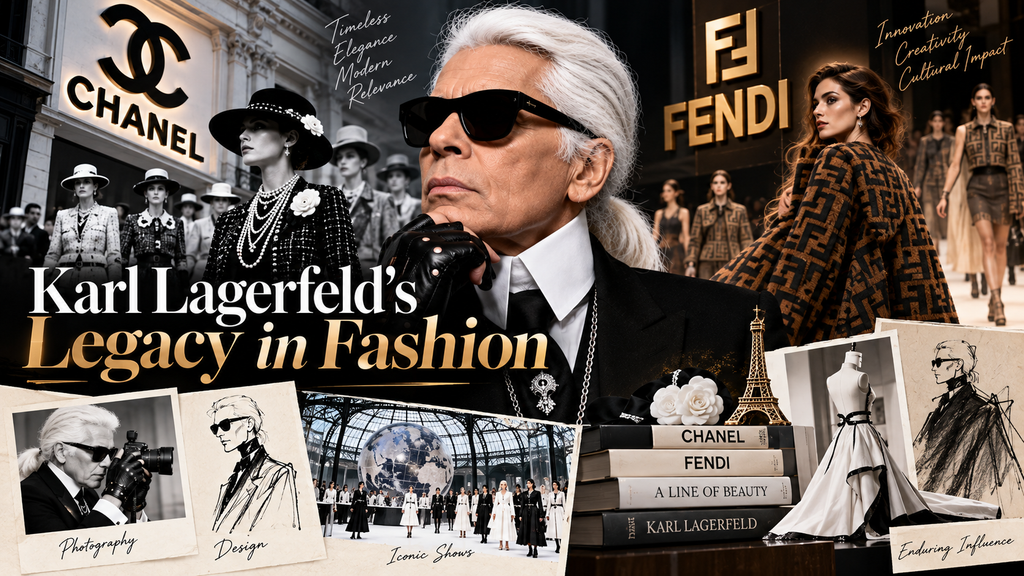
His Chanel career showed how a historic fashion house could preserve recognizable codes while continuing to evolve. Chanel’s own history credits him with revitalizing the house in multiple areas.
Long-Term Creative Direction
His 54-year collaboration with Fendi is an extraordinary example of sustained creative partnership.
Fashion and Photography
He demonstrated how the person designing a collection could also control its photographic presentation and visual storytelling.
Designer Collaborations
His H&M collaboration helped popularize a model in which established designers worked with mass-market retailers.
Personal Branding
His highly recognizable appearance showed how a designer’s own public identity could become an extension of a fashion brand.
Karl Lagerfeld: A Line of Beauty
In 2023, The Metropolitan Museum of Art presented Karl Lagerfeld: A Line of Beauty, an exhibition devoted to his creative work. The exhibition covered his 65-year career and included designs associated with Balmain, Patou, Chloé, Fendi, Chanel and his own label. Approximately 150 pieces were displayed alongside Lagerfeld’s sketches, allowing visitors to examine the relationship between his drawings and finished garments.
The exhibition was important because it examined Lagerfeld as a designer and creative practitioner rather than focusing only on his celebrity image. It showed how his sketches, ideas and working methods could be studied as a coherent body of work.
What Fashion Can Learn From Karl Lagerfeld
Karl Lagerfeld’s career offers several lessons for anyone interested in fashion. The first is that heritage can be a starting point rather than a limitation.
The second is that a fashion brand is more than clothing. Photography, storytelling, presentation, collaborations and visual identity all contribute to how audiences experience a brand.
The third is the value of adaptability. Lagerfeld worked across different houses with different histories, audiences and design languages. The fact that he could operate differently at Chanel, Fendi, Chloé and his own label demonstrates how important context is in creative direction.
Frequently Asked Questions About Karl Lagerfeld
Who was Karl Lagerfeld?
Karl Lagerfeld was a German-born fashion designer whose approximately 65-year career included major creative roles at Fendi, Chloé and Chanel, as well as work under his own name.
When did Karl Lagerfeld join Chanel?
Karl Lagerfeld became Artistic Director of Chanel in 1983.
When did Karl Lagerfeld start working with Fendi?
Lagerfeld began working with Fendi in 1965, and the collaboration continued for 54 years.
What was Karl Lagerfeld famous for?
He was known for his work at Chanel and Fendi, his own fashion label, photography, publishing, runway productions and distinctive personal style.
What did Karl Lagerfeld do at Chanel?
He helped modernize Chanel’s collections, strengthen ready-to-wear, restore haute couture prominence and develop the Métiers d’Art and pre-collection formats.
What was Karl Lagerfeld’s relationship with Fendi?
Lagerfeld joined Fendi in 1965 as its first Artistic Director and worked with the house for 54 years. He also created the famous FF logo early in the relationship.
Did Karl Lagerfeld have his own fashion brand?
Yes. He established his namesake ready-to-wear label in 1984.
Why was Karl Lagerfeld’s H&M collaboration important?
His 2004 collaboration became an important example of an established designer working with a high-street retailer and helped popularize designer–retailer collaborations.
When did Karl Lagerfeld die?
Karl Lagerfeld died in Paris on 19 February 2019, aged 85.
Final Thoughts
Karl Lagerfeld’s story is much bigger than the famous sunglasses, white ponytail and black suits.
His career crossed generations, countries, fashion houses and creative disciplines. From Fendi’s Rome-based craftsmanship to Chanel’s French heritage, from Chloé’s romantic designs to his own label, he repeatedly demonstrated an ability to adapt his creativity to different environments.
His influence can also be seen beyond the runway. He helped connect fashion with photography, publishing, celebrity culture, large-scale visual storytelling and designer collaborations.
The Metropolitan Museum’s A Line of Beauty ultimately placed his work in a broader historical context, examining the drawings, garments and creative methods behind a career that lasted around 65 years.
For anyone studying fashion history, luxury branding or modern creative direction, Karl Lagerfeld remains an important figure to understand—not because his career was without controversy, but because of the scale, duration and variety of the work he produced.