

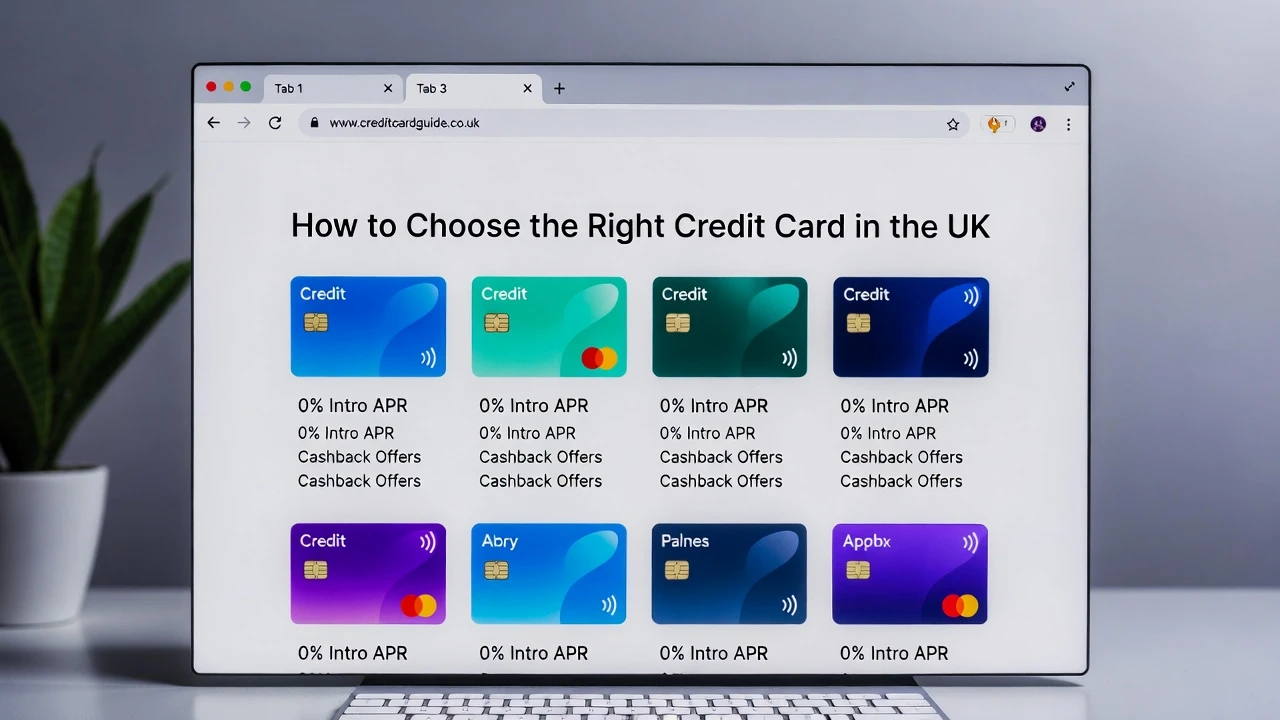
- Defining Your Purpose Before Comparing Cards
- Understanding How Credit Cards Operate in the UK
- Types of Credit Cards Available to UK Consumers
- Regulatory Protections and Consumer Safeguards
- Credit Checks and Eligibility in Practice
- Costs Beyond the Headline Interest Rate
- Practical UK Scenario Examples
- Advantages and Limitations
- Factors That Influence Approval and Suitability
- Common Errors When Selecting a Card
- Is Choosing the Right Credit Card Worth the Effort?
- Frequently Asked Questions
Choosing a credit card in the UK is not about finding the “best” card overall. It is about identifying which product fits your financial behaviour, repayment ability, and long-term goals. With hundreds of options available from high street banks and digital lenders, understanding how different features work under UK regulation is essential before applying.
Credit cards in the UK are regulated by the Financial Conduct Authority (FCA), and certain purchases are protected under Section 75 of the Consumer Credit Act. That means the decision you make has legal, financial, and credit score implications. This guide explains how to approach that decision carefully and practically.
Defining Your Purpose Before Comparing Cards
The first step is clarity. Why do you need the card?
Some people want to spread the cost of a £1,200 laptop over several months. Others want to transfer existing debt to reduce interest. Some want cashback on everyday supermarket spending. A smaller group may need to rebuild their credit history.
If you plan to repay the full balance every month, interest rates matter less, and rewards may be more relevant. If you expect to carry a balance, the Annual Percentage Rate (APR) becomes a primary factor. Choosing without defining your goal often leads to paying unnecessary fees or interest.
Understanding How Credit Cards Operate in the UK
UK credit cards use a revolving credit system. You are given a credit limit, for example £3,000. You can spend up to that amount and repay part or all of it each month.
Here is how the system works in practice:
- You make purchases during a billing cycle (usually around 30 days).
- You receive a statement showing your balance and minimum payment.
- If you pay the full balance by the due date, you usually avoid interest on purchases.
- If you pay only part, interest is charged on the remaining balance unless you are in a 0% promotional period.
Most lenders display a Representative APR. This is the rate at least 51% of approved applicants must receive. Your actual rate may differ depending on income and credit history.
Types of Credit Cards Available to UK Consumers
Different credit cards are designed for different situations. Selecting the wrong type can reduce the benefit.
Balance transfer cards allow you to move existing debt from another card and often offer 0% interest for a fixed introductory period. They may charge a transfer fee, typically 2%–5% of the amount moved.
Purchase cards provide 0% interest on new spending for a promotional period. These are often used for planned large purchases.
Credit builder cards are aimed at people with limited or poor credit history. They usually have lower credit limits and higher APRs but can help improve your credit profile if managed responsibly.
Rewards and cashback cards return a small percentage of spending or offer points. These tend to benefit people who repay in full every month.
Travel cards may reduce foreign transaction fees when spending abroad, which can otherwise be around 2%–3%.
Regulatory Protections and Consumer Safeguards
One key advantage of UK credit cards is legal protection. Under Section 75 of the Consumer Credit Act, purchases between £100 and £30,000 may be jointly protected by the card provider if the supplier fails to deliver goods or services.
For example, if you pay £800 for furniture that never arrives, you may be able to claim a refund from your card provider.
Credit card providers must also follow FCA rules on clear disclosure of costs, summary boxes, and responsible lending assessments. These safeguards help consumers compare products transparently.
Credit Checks and Eligibility in Practice
Before approval, lenders carry out a credit assessment. This often includes a “hard search,” which leaves a visible record on your credit file.
Many lenders now offer eligibility checkers that perform a “soft search.” A soft search does not affect your credit score and allows you to see your likelihood of approval before formally applying.
Multiple hard searches in a short period can reduce your credit score, as it may signal financial stress to lenders. Therefore, it is sensible to check eligibility first rather than applying repeatedly.
Costs Beyond the Headline Interest Rate
APR is important, but it is not the only cost to consider.
Some cards charge annual fees. Others may charge foreign transaction fees or cash withdrawal fees. Cash advances typically attract higher interest rates and may not benefit from interest-free periods.
Minimum payments are often around 2%–3% of the balance or £5, whichever is higher. Paying only the minimum reduces immediate pressure but increases long-term interest costs significantly.
Understanding the full fee structure prevents unexpected charges later.
Practical UK Scenario Examples
Consider a borrower transferring £4,000 to a 0% balance transfer card with a 3% fee. The upfront fee would be £120. If the promotional period lasts 18 months and the borrower clears the balance within that time, they may avoid hundreds of pounds in interest compared to a 24% APR card.
Alternatively, someone spending £1,000 per month on a cashback card offering 1% could earn around £120 annually, provided they repay in full and avoid interest.
These examples show that the right card depends on disciplined repayment and clear planning.
Advantages and Limitations
Below is a simplified comparison:
Type of Card | Main Benefit | Main Risk
Balance Transfer | Temporary 0% interest on debt | Fees and high rate after promo
Purchase Card | Spread cost interest-free | Interest if balance not cleared
Rewards Card | Cashback or points | Interest outweighs rewards if not repaid
Credit Builder | Improves credit profile | Higher APR
This overview highlights trade-offs rather than promising savings.
Factors That Influence Approval and Suitability
Several elements affect which card is appropriate:
Income stability matters because lenders assess affordability.
Credit score influences the APR and limit offered.
Existing debt affects your credit utilisation ratio.
Spending behaviour determines whether rewards are worthwhile.
Repayment discipline reduces long-term cost.
Matching these factors with the card’s features leads to better outcomes.
Common Errors When Selecting a Card
One common mistake is focusing solely on the promotional rate and ignoring what happens after it ends. Another is underestimating how long it will take to clear a balance.
Some applicants apply for multiple cards at once, which can negatively affect their credit profile. Others withdraw cash without realising that interest applies immediately.
Careful reading of the summary box and credit agreement can prevent these issues.
Is Choosing the Right Credit Card Worth the Effort?
For UK consumers, taking time to evaluate options can reduce borrowing costs and improve financial flexibility. A suitable card can provide purchase protection, structured repayment options, and even modest rewards.
However, if spending is difficult to control or repayment capacity is uncertain, a debit card or structured personal loan may be more appropriate. Credit cards are tools; their value depends on responsible use.
Frequently Asked Questions
What APR is considered competitive in the UK?
Competitive rates vary depending on credit profile, but lower APRs are generally offered to applicants with strong credit histories. Representative APRs around 20%–25% are common, though individual offers differ. Credit unions often have a statutory cap (e.g. 42.6% APR in England, Wales, Scotland) which can be far lower than some short-term lenders.
Does checking eligibility affect my credit score?
Eligibility checkers typically use a soft search, which does not impact your credit score. A full application usually triggers a hard search. Credit unions may also use their own affordability assessments that focus on your income and outgoings, not solely a credit score.
Can I hold more than one credit card?
Yes, many consumers hold multiple cards for different purposes. However, overall credit utilisation and repayment capacity remain important considerations. With a credit union, membership is single, but you can still have external credit cards. Some people use a credit union loan to consolidate card debt.
What happens if I miss a payment?
Missing a payment may result in a late fee and could negatively affect your credit file. Interest charges may also increase depending on the card terms. Credit unions are often more understanding if you communicate early – they may offer a repayment holiday or restructure the loan, but charges still apply if you miss without agreement.
Are prepaid cards the same as credit cards?
No. Prepaid cards use money you load in advance and do not involve borrowing. They are not the same as regulated credit agreements. Credit union current accounts sometimes offer a debit card (not prepaid) which gives you access to your own savings, while a credit union loan is a separate credit product.
💡 always check the product type: a prepaid card won’t build your credit history.