
- What Is a Credit Card?
- How Do Credit Cards Work?
- Is a Credit Card Suitable for You?
- Credit Card Interest Rates and Fees Explained
- Credit Card Limits
- Key Factors to Consider When Choosing a Credit Card
- Pros and Cons of Different Credit Card Types
- Common Mistakes to Avoid
- Are Credit Cards Worth It for UK Users?
- Frequently Asked Questions
Credit cards are one of the most widely used financial tools in the UK. Whether you want to spread the cost of a large purchase, earn rewards, transfer existing debt, or build your credit score, there are many different types of credit cards designed for specific needs.
However, not all credit cards work the same way — and choosing the wrong type can cost you money in interest and fees. This guide explains how credit cards work in the UK, the main types available, and how to decide which one is right for you.
What Is a Credit Card?
A credit card is a form of revolving credit, meaning a lender gives you a credit limit and you can borrow up to that amount repeatedly, as long as you repay at least the minimum each month.
Credit Limit Explained
Your credit limit is the maximum amount you can borrow. For example, if your limit is £3,000, you cannot spend more than that unless the lender increases your limit. The amount you’re offered depends on your income, credit history, and overall financial profile.
How Repayment Works (Minimum vs Full Payment)
Each month, you receive a statement showing:
- Total balance
- Minimum payment
- Payment due date
If you pay the full balance, you usually avoid interest on purchases. If you pay only the minimum, interest is charged on the remaining balance.
UK Regulation (FCA Overview)
Credit cards in the UK are regulated by the Financial Conduct Authority (FCA). Lenders must provide clear terms, responsible lending checks, and transparent fee disclosures.
Section 75 Protection (£100–£30,000)
Under the Consumer Credit Act 1974, Section 75 gives protection on purchases between £100 and £30,000. If a retailer fails to deliver goods or services, the credit card provider can be jointly liable.
How Do Credit Cards Work?
Understanding the mechanics helps avoid unnecessary costs.
Borrowing Process
When you use a credit card, the provider pays the retailer on your behalf. You then repay the lender.
Billing Cycle
Most UK cards operate on a monthly billing cycle. At the end of each cycle, a statement is issued.
Interest-Free Period
If you repay your full balance by the due date, you can benefit from an interest-free period (often up to 56 days).
APR (Variable vs Fixed)
APR (Annual Percentage Rate) reflects the yearly cost of borrowing including interest and certain fees. Most UK credit cards have variable APRs, meaning rates can change.
Impact on Credit Score
Using a credit card responsibly can improve your credit score. However:
- Missed payments lower your score
- High credit utilisation can reduce your rating
- Multiple applications in a short period can signal risk
Minimum Payments Explained
Minimum payments are usually around 1–3% of your balance. Paying only the minimum can significantly increase the total interest paid over time.
Is a Credit Card Suitable for You?
Credit cards are useful but not suitable for everyone.
Responsible Borrowing Considerations
You should be confident in your ability to repay what you borrow. Credit cards are not free money — interest can accumulate quickly.
Income Stability
If your income is irregular or uncertain, a credit card may create repayment pressure.
Spending Habits
If you tend to overspend, a debit card may be safer.
Risks of Missed Payments
Late payments can lead to:
- Late fees
- Higher interest rates
- Damage to your credit file
When a Debit Card or Loan May Be Better
- For fixed long-term borrowing → a personal loan may offer lower interest.
- For daily spending control → a debit card prevents borrowing altogether.
Main Types of Credit Cards in the UK
There are several types of credit cards, each designed for different purposes.
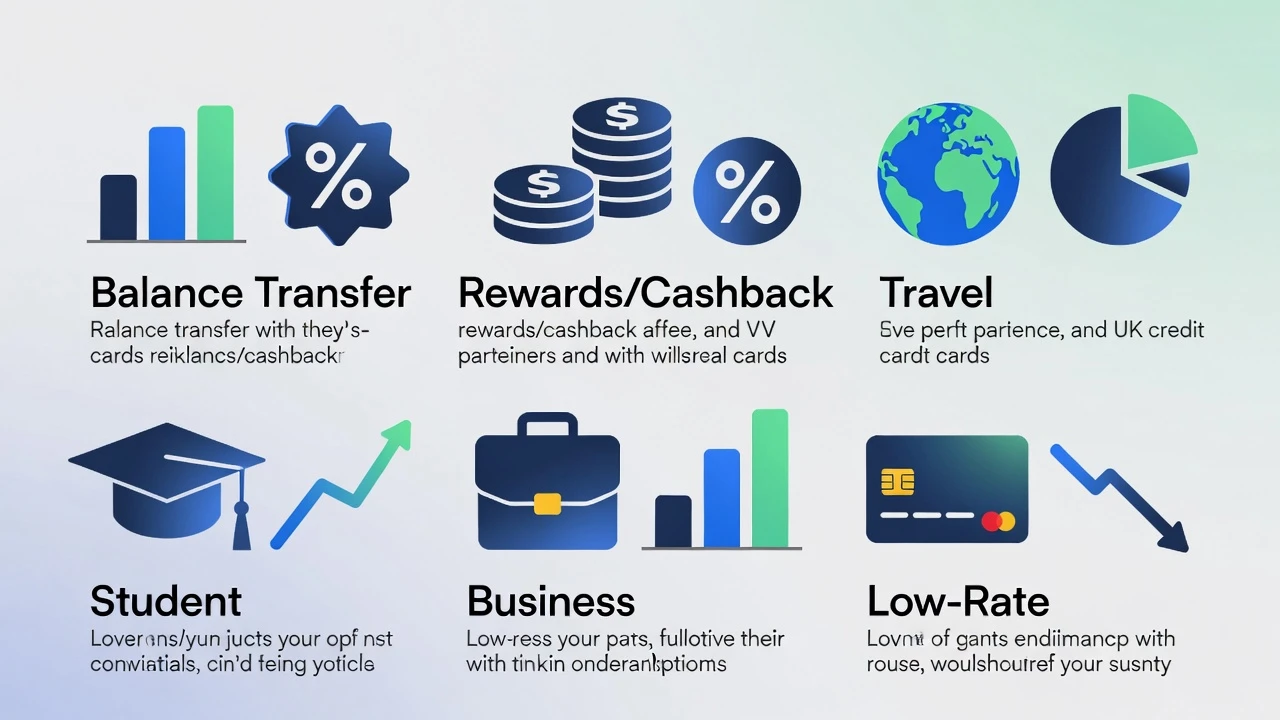
1. Balance Transfer Credit Cards
These allow you to move existing credit card debt to a new card, often with a 0% introductory interest period.
- Transfer fees typically 2–5%
- Useful for debt consolidation
- Interest applies after the promotional period ends
Best for: Reducing interest on existing balances.
2. Purchase (0% Interest) Credit Cards
Offer 0% interest on new purchases for a set period.
- Ideal for spreading the cost of large purchases
- No interest during promotional period
- Standard APR applies afterward
Best for: Planned major expenses.
3. Combined Purchase and Balance Transfer Cards
Offer both features but often with shorter promotional periods.
Best for: Flexibility if you need both spending and debt transfer options.
4. Credit Builder & Poor Credit Cards
Designed for people with limited or damaged credit histories.
- Lower credit limits
- Higher APR
- Can help rebuild credit with responsible use
Best for: Improving credit score over time.
5. Rewards & Cashback Credit Cards
Provide incentives for spending.
- Cashback percentages on purchases
- Travel points or air miles
- Some have annual fees
Best for: People who repay in full every month.
6. Low-Rate & Fixed-Rate Credit Cards
Offer lower standard interest rates.
- Suitable for occasional borrowing
- More predictable costs
Best for: Carrying small balances occasionally.
7. Travel / Overseas Credit Cards
Designed for international spending.
- No foreign transaction fees
- Competitive exchange rates
- Cash withdrawals may still incur charges
Best for: Frequent travellers.
8. Money Transfer Credit Cards
Allow you to transfer funds directly to your bank account.
- Transfer fee usually applies
- Useful for clearing overdrafts
Best for: Managing short-term financial pressure.
9. Student Credit Cards
Designed for university students.
- Lower limits
- Help build early credit history
- High interest if misused
10. Business Credit Cards
Used for company expenses.
- Separate personal and business spending
- May not always include Section 75 protection
11. Prepaid Cards (Not True Credit Cards)
Prepaid cards require you to load money before spending.
- No borrowing
- No credit checks
- Not the same as a credit card
Credit Card Interest Rates and Fees Explained
Before applying, understand all potential costs:
- Purchase APR
- Cash advance APR (usually higher)
- Balance transfer fees
- Annual fees
- Foreign transaction fees
- Late payment charges
Always check the representative APR.
Credit Card Limits
Lenders decide limits based on:
- Income
- Credit history
- Existing debts
Keeping credit utilisation below 30% of your limit is often considered healthy for your credit score.
Key Factors to Consider When Choosing a Credit Card
Ask yourself:
- What is the purpose?
- Can I repay in full monthly?
- What happens after the promotional period?
- Do benefits outweigh fees?
Choosing based on your financial behaviour is more important than chasing offers.
Pros and Cons of Different Credit Card Types
| Type | Best For | Main Benefit | Main Risk |
|---|---|---|---|
| Balance Transfer | Debt consolidation | 0% intro interest | High interest after promo |
| Purchase Card | Large planned spending | Spread cost interest-free | Missed promo deadline |
| Rewards Card | Regular spenders | Cashback/points | Interest cancels rewards |
| Credit Builder | Poor credit | Improves score | High APR |
Common Mistakes to Avoid
- Paying only the minimum
- Missing 0% deadlines
- Ignoring transfer fees
- Applying for too many cards
- Using cards for frequent cash withdrawals
Are Credit Cards Worth It for UK Users?
Credit cards can be valuable tools when used responsibly. They offer:
- Consumer protection
- Flexibility
- Rewards opportunities
- Credit score improvement
However, they are not suitable for unmanaged debt or impulsive spending. The key is disciplined repayment.
Frequently Asked Questions
🇬🇧 UK beginner’s guideCredit builder cards (also called starter cards) are designed for people with limited credit history. They often have lower limits and higher representative APRs, but responsible use helps build a positive credit file. Some high-street banks and specialist providers offer them.
Yes, options exist — typically credit builder / bad credit cards. They may come with a higher APR (often around 30‑40% representative) and lower credit limits. Some providers offer an eligibility checker without affecting your credit score.
Applying for any card leaves a hard search on your file, which can temporarily lower your score by a few points. However, using a balance transfer to consolidate and reduce outstanding debt can improve your credit utilisation and boost your score in the medium term.
After the promotional 0% interest period expires, the standard variable APR applies to any remaining balance. This rate can be significantly higher. To avoid interest, try to clear the balance before the 0% end date, or consider a new balance transfer deal.
No. Prepaid cards (like Pockit, Suits Me) are not credit products — you spend money you’ve loaded in advance. They don’t involve borrowing, and generally don’t report to credit reference agencies, so they won’t build your credit history. Credit cards offer a line of credit and affect your credit file.